TOP SECRET
OPERATION ICEBERG
(Enclesure No. 3 to A.C.1's No. 0109/12/867 of 14th May, 1945)
DEFENSIVE AIR OPERATIONS - SUMMARY
PERIOD : 4th May and 5th May, 1945.
4th May.
At 0550 the first of several small bogies was detected tracking East. All these bogies passed between 40 and 70 miles North of the Task Force. An interception was attempted on 6 of these small formations or singles. Owing to distance and cloud only one interception was successful and two Zekes were splashed at 0635.
The Easterly traffic ceased about 0730.
2. At 0816 a very high snooper was detected; an interception failed because no fighters had sufficient oxygen to reach it. The Task Force was thoroughly snooped between 0830 and 0840.
3. At 1102 a few bogies were detected 50 miles 250 degrees. An interception was started with Seafires and Corsairs. At 1104, a second enemy formation was detected 65 miles due West. An interception was immediately started. At 1107 a further bogey was detected and fighters sent out. By now it seemed probable that an attack on the Task Group was intended. Task Group 57.2, which was detaching to bombard, but was still in V.H/F. touch, was warned.
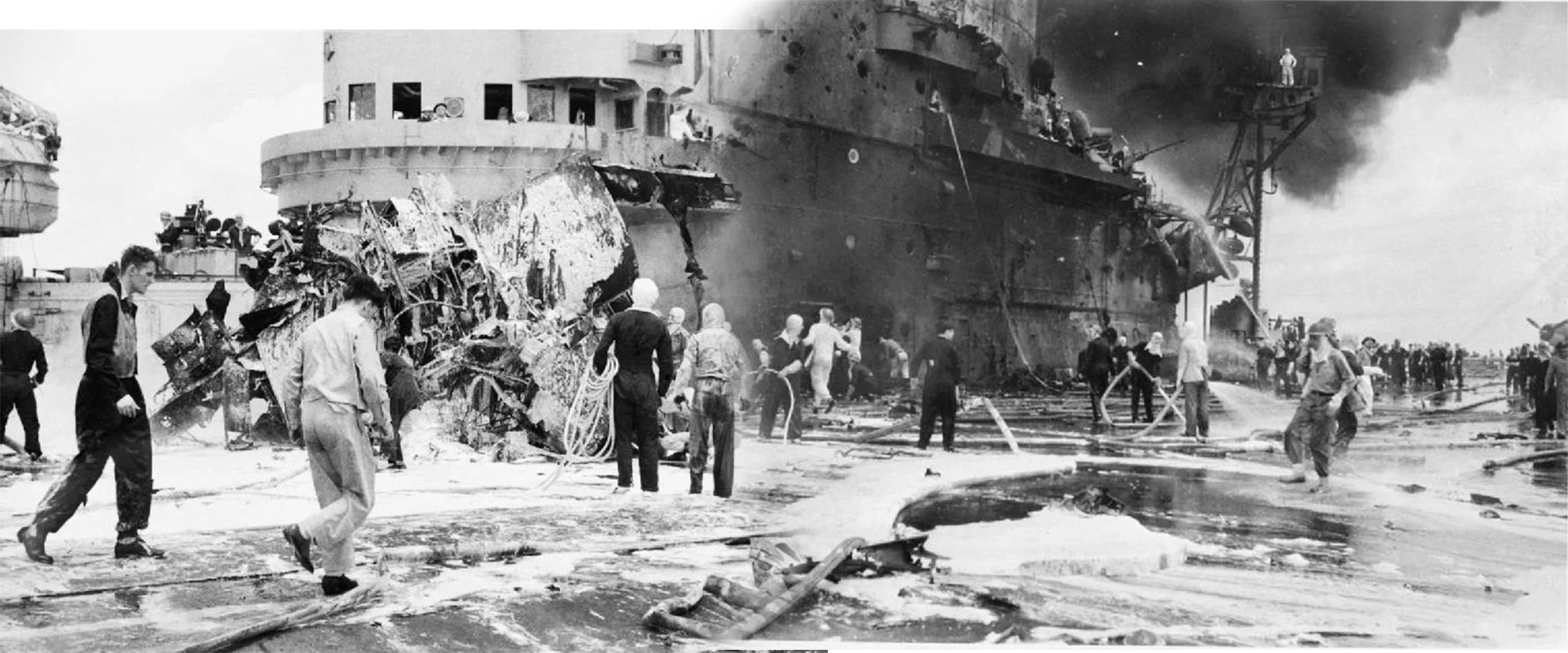
4. All bogies closed straight into Task Group 57.1; they took effective anti-radar measures by changing height and track frequently. A late interception splashed two. During the latter part of the enemy's approach all carriers were primarily interested in interception and there is no doubt that the air warning of the Flect in the absence of battleships and cruisers was unduly weakened. As a result a small raid of probably 3 bandits got in completely undetected.
FORMIDABLE was hit at a time when the air plot had no bogies nearer than 20 miles.
5. The remaining bogies, many of whom were probably decoys, withdrew fast.
6. The worst results of a well-planned and well-executed attack were prevented by the gunfire of the Fleet. The air warning and fighter direction organization failed either to protect the Fleet or adequately warn them. Not the least of the difficulties presented by effective anti-radar measures is that it is impossible to analyze them. It is, however, obvious that only the utmost alertness on the part of the Fighter Direction Officers, Radar officers and operators will prevent a recurrence of this regrettable failure.
7. At 1220 a single bogey was detected 40 miles South West; it was intercepted, found to be a Jill and was splashed.
8. At 1237 a high anooper was detected and fighters were sent out. After a lot of oxygen trouble it was finally intercepted by Corsairs, found to be a Judy and splashed.
9. At 1242 a single bogey was detected 50 miles East. It was intercepted, found to be a Val and was splashed.
10. At 1545 another high snooper was detected and fighters sent out at 30,000 feet; after several attempts it was finally intercepted at 1712 at 24,000 feet, found to be a Judy and splished.
93
TOP SECRET
OPERATION ICEBERG
(Enclosure No. 3 to A.C.1's No. 0109/12/867 of 14th May, 1945)
DEFENSIVE AIR OPERATIONS - SUMMARY (Page 2.
PERIOD : 4th May and 5th May, 1945.
4th May. (Conte)
11. At 1719 a few bogies were detected 40 miles South West, closing. Seafires and a long stop of Corsairs were sent out. The Seafires intercepted, found 4 Zekes and splashed 3; the fourth escaped to the North West:
12. At 1811 a single bogey was detected 75 miles to the West, closing; it was intercepted, found to be a Zeke and was splashed. This was probably the Zeke who escaped from the earlier interception and who was of the opinion that death was preferable to a dishonourable return to base.
5th May.
13. At 0455 a single bogey opening was detected 30 miles North East; it opened to 50 miles where it faded and did not return.
14. At 0732 a high snooper was detected 80 miles North West. A chase was started which lasted for nearly two hours, covered over 300 air miles and exhausted the oxygen of three divisions of fighters. The bogey did everything he knew to avoid interception and succeeded in snooping us but was finally intercepted, identified as a Zeke and splashed.
15. There were no further bogey detections throughout the day.
OXYGEN
16. The oxygen systems of Hollcats and Corsairs are not satisfactory. It is constantly necessary to reorganise divisions while on station because one or more aircraft have run out of oxygen after only a few minutes at 20,000 feet.