Navy Department
Bureau of Ships
CONFIDENTIAL Memorandum August 30, 1941
From: Lt. O. M. Browne, U.S.N.
To: The Head of the Design Division.
Subject: Temporary Duty Travel — Inspection of Damage to Request No. 129.
Reference:
(a) Bureau Memorandum No. 12.
In accordance with verbal authority granted August 28, 1941 I reported to the Commandant, Norfolk Navy Yard on August 29, 1941 for the purpose of examining the damage to work request No. 129. This duty was completed on the above date and I returned to the Bureau on August 30, being absent from the Bureau during the working hours of one day.
The damage was examined in company with Lt. H. R. Garner, U.S.N., Mr. Wise of the Norfolk Navy Yard and Comdr. (E) C. H. Bennet, R.N. of the 129. Comdr. Bennet is engineer officer of the vessel, and was stationed in the engine room during the attacks of 26 May, 1941 off Crete. He had full knowledge of the attacks and the resulting damage, however, and was in charge of clearing the wreckage and accomplishment of temporary repairs. He was most cooperative and agreeable in showing us the damaged areas and in explaining the circumstances.
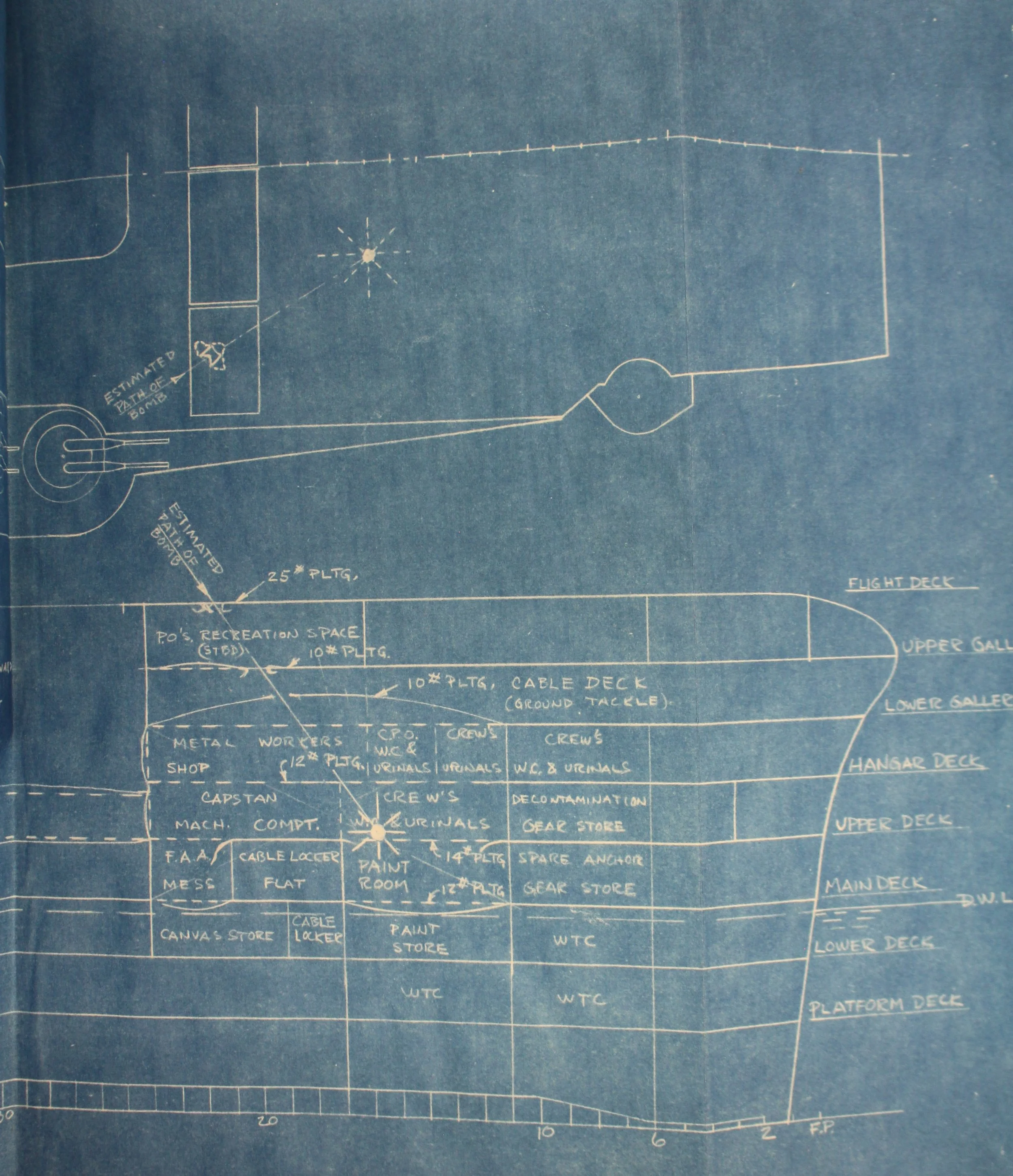
The ship HMS Formidable was subjected to a dive bombing attack between 1330 and 1400 on 26 May, 1941. Of a large number of bombs dropped in the vicinity of the ship only two, estimated to be approximately 1000# bombs, were hits. The first struck the 25# plating of the flight deck at frame 21-1/2, forward of the forward elevator, approximately 27 feet to starboard of the centerline at an angle of about 40° from the vertical. The bomb came from aft
Page 2 Memorandum
and starboard, the plane of its trajectory making an angle of about 30° with the centerline. The plating around the hole in the flight deck was torn transversely and longitudinally and turned down in four petals. The diameter of the bomb could not be determined from this hole, which was large enough to pass a 20-inch cylinder at an obliquity of 40°. The deck itself had been patched but the section, about 4 feet square containing the bomb hole had been preserved in the hangar. The bomb passed also through the upper gallery 10#, lower gallery 10#, hangar 12# and upper decks and exploded between on or near the upper and main deck.The shell plating between frame 11 and frame 24 from the lower gallery deck to the main deck was blown out and most of it folded downward. The main deck was bowed down and torn. Stanchions below this deck were buckled. The greatest effect, however, was outward toward the starboard side and upward. The upper deck was demolished on the starboard side and the capstan machinery on this deck was wrecked. The cast iron motor casings were reported to have disintegrated. There appeared to be little damage to worms and worm wheels. The hangar deck above was bulged upward and torn over the point of explosion. Tears were noted to have crossed but not to have followed welds. Bulkhead 24 was distorted. Blast passed through a door in this bulkhead between the upper and hangar decks, bulging the upper deck plating downward and the lift well plating upward aft of the bulkhead. Ten men were killed in this compartment, which was an ammunition handling space, at least one from flash burns owing to insufficient clothing.
The lower gallery deck was bulged up from frame 11 to frame 24 from side to side. The maximum height of the bulge was approximately 4 feet over the center of the explosion. It was particularly noted that while the plating of this deck was considerably stretched no welded seams or butts had failed. The only failure was in a riveted connection at bulkhead 24. This deck, being the cable deck, had been wood covered, but most of it the wood was missing at the time of the inspection. There were a few small fragment holes. The relatively small fragment damage noted points to the possibility that the bomb was a light- or medium-case bomb.
Page 3 MemorandumThe upper gallery deck was bulged upward a maximum of about 6 inches. Evidence of heavy loading of stanchions on this deck was noted, particularly where the upper end connection was slightly eccentric. The bulkheads in this region around the lift well were distorted, causing jamming of the guides and counter balance weights putting the elevator temporarily out of commission.
The hit aft struck just outboard of X-1 twin mounting, the forward mount of after starboard group, and grazed the lower part of the rotating structure of the mount. Two men, the only casualties from this bomb, were killed at this point. The bomb then passed through the deck of the handling room and passed out of the ship through the lower plating of the sponson. The angle from the vertical of its trajectory was less than that of the forward bomb, being perhaps 30°. Its plane was approximately perpendicular to the center line of the ship. The bomb is thought to have glanced off the side of the ship at frame 155. It detonated below the water and caused flooding of three compartments by opening of seams. No fragment attack was noted and Comdr. Bennett thought the underwater damage was stated to be not extensive. This damage was inaccessible at the time of the inspection. A starboard strut arm was fractured and some shaft bearing foundations and other castings were fractured. The ship was able, however, to continue steaming on all three shafts.
The ship, with the assistance of Egyptian labor at Alexandria, had made very creditable temporary repairs. The damaged side plating forward had been replaced but not faired. This was accomplished by lightening the bow, bringing the damage above the waterline. The main deck, upper and lower gallery decks and bulkhead 24 had been made watertight. Much of the damaged plating had been cleared away so that when the damaged region was inspected, the space between the lower gallery deck and the main deck from side to side between bulkheads 11 and 24 was just one large watertight compartment with partial intermediate decks on the port side.
There was no fire damage. The report of fire was brought about by the burning of 30 gallons of paraffin oil in the fleet air arm shop which gave off dense clouds
Page 4 Memorandum
of black smoke and blackened the structure in the vicinity.We were shown a set of pictures taken immediately after the attack. Comdr. Bennett stated that they would be made available to the Yard for use in their report. Lt. Comdr. Honsinger was so informed in discussing the Yard’s report on this vessel.
O. M. BROWNE.