TOP SECRET
OPERATION ICEBERG
(Enclosure No. 3 to A.C.1's No. 0109/12/867 of 14th May, 1945)
DEFENSIVE AIR OPERATIONS - SUMMARY
(Page 2. PERIOD : 8th May and 9th May. 1945.
8th May.
17.
The weather in the target area was prohibitive and the TG withdrew. Nothing of interest happened throughout the day.
9th May.
18. At 1143 a very high smooper was detected 90 miles west. An interception was started with Hellcats at 30,000 feet. The snooper closed to 30 miles at which range fighters were close, but the interception failed, mainly because of poor communications with the fighters. The snooper withdrew fast to the North; it was chased by Corsairs but escaped.
19. At 1250 same enemy activity, very high, was detected to the West. Fighters wore sent out but a track was not obtained and the fighters returned.
94
TOP SECRET
OPERATION ICEBERG
(Enolosure No. 3 to A.C.1's No.0109/12/867 of 14th May, 1945.)
(Page 3.
DEFENSIVE AIR OPERATIONS - SUMMARY
PERIOD : 8th May and 9th May, 1945 (Contd.)
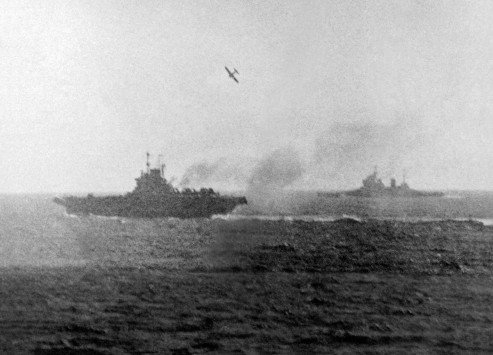
20. At 1645 five low bogies were detected 25 miles to the westward. Two divisions of Seafires were immediately sent out; one division intercepted at 15 miles but allowed to be drawn off by one ZEKE which retired to the Westward and was later splashed. The second interception failed. The four remaining ZEKES attacked the Fleet.
21. The attack was in the same form as that on 4th May. The plot was complicated by decoys. The approach of the KAMIKAZES was very low until sighting the Fleet when they climbed steeply to 5000 feet, from which height the final approach was made in a shallow dive.
22. The conclusions drawn from the attacks on 4th and 9th May are that the enemy, having failed to penetrate our fighter defences at medium and high altitudes, is now trying low. His first two attacks have succeeded.
23. Effective countermeasures depend on extending our low warning. It is hoped that this may be achieved by the use of picket cruisers.
95